Question: But What Can I Do?
Answer: A Lot!
These suggested Action Items, at every level, are all designed to move us closer to our goals of stopping the land application of toxic sewage sludge in Virginia and charting a course toward waste solutions that are actually sensible and sustainable.
VPA permits are active in several Virginia counties at any given time. If you need organizing help with your county, please get in touch via the Contact page to let us know.
Person-to-Person: Connect with Your Neighbors
This is a grassroots movement. Your voice matters and one-to-one communication is essential. Ways to help:
Educate yourself about sludge, then talk with your neighbors, family and friends about it — especially if some of those people are farmers. Help them get educated, too.
Sign up for newsletters and alerts from us (check the sign-up box in the form on our Contact page), then help spread the word about events, educational opportunities, and action campaigns via your social media and social network.
Submit written comments and encourage others to do so. See more in the local government and DEQ sections below.

Want Help?
Download our comment-writing instructions and a template for VPA01587 HERE.
State Regulators: Virginia Department of Environmental Quality (DEQ)
Virginia’s DEQ is in charge of administering the law regarding sludge, including creating regulations and rules around permits. DEQ has a long history of dismissing citizen concerns and favoring the sludge-spreading industry.
There is an opportunity to put serious pressure on DEQ, however, by engaging en masse in the public comment process. Every time a company wants to spread sewage sludge in a county, it has to apply for a VPA permit from DEQ. When those applications are open for public comment, they are posted on DEQ’s Virginia Pollution Abatement (VPA) page, and the comment period lasts 30 days.
If enough people submit comments that request a public hearing, then DEQ will hold a public hearing about that particular permit application. Public hearings are very important. They slow down the permitting process, provide a public forum in which neighbors can voice their concerns, provide an opportunity for media coverage and an opportunity to educate the public about biosolids more broadly.
Participate
DEQ accepts comments on permit applications via email and not through a public portal, so the comments of others are not easily accessible to the public. Click on the blue rectangle of a county’s application notice on the VPA page to find the email address of the person in charge of that permit, along with all the other info you’ll need for your comment. For this permit, VPA01587, send comments to Mattie Jenkins. Also, cc Neil Zahradka, (neil.zahradka@deq.virginia.gov) the long-time manager of the state’s biosolids program.
First Comment Period: Demand a Public Hearing
Comments Are Needed! 25 unique comments are required before DEQ will consider a public hearing on permit applications. Submit your comments asking for a hearing during the first 30-day comment period.
The First 30-Day Comment Period for the Albemarle County permit application VPA01587 is Now Open! See ADD YOUR VOICE for templates and details on how to submit a comment.
When a Public Hearing is Granted…
If you succeed in getting those 25 comments and DEQ holds a public hearing, a second 30-day comment period will be announced. Try to get as many people as possible to come to the public hearing and present their comments about biosolids there, in person. Comments may also be submitted as emails during this comment period. Find email addresses and other pertinent info on the VPA Public Notices page of the DEQ site.
Invite the media. The Public Hearing is a great opportunity for reporters to get a lot of information in a short period of time. Include local TV, Substack journalists, newspaper reporters, and anyone else you can think of to inform the public about biosolids.
Other Opportunities
Additionally, whenever DEQ proposes changes to its rules, including those regarding biosolids and clean water, or announces public hearings, those will be posted for public comment on the Virginia Regulatory Town Hall website. The site is clunky and hard to navigate, but you can register and sign up for alerts as well as post comments that will become part of the public record and read the comments of others. Read this Town Hall User Manual for help using the system.

Local Governments
The strategies outlined below apply to our work in Albemarle County, specifically. But every county or town in Virginia has similar government structures and groups of procedures, so if you are not an Albemarle resident, you can still take these ideas and apply them to your county. (If you need help, contact us.)
Sign On in Support of a Biosolids Ordinance in Albemarle
Join a coalition of organizations, businesses, and individuals as we call on our county’s Board of Supervisors to adopt a biosolids ordinance that will take full advantage of a county’s authority to test, monitor, and regulate the land application of sewage sludge within its borders.
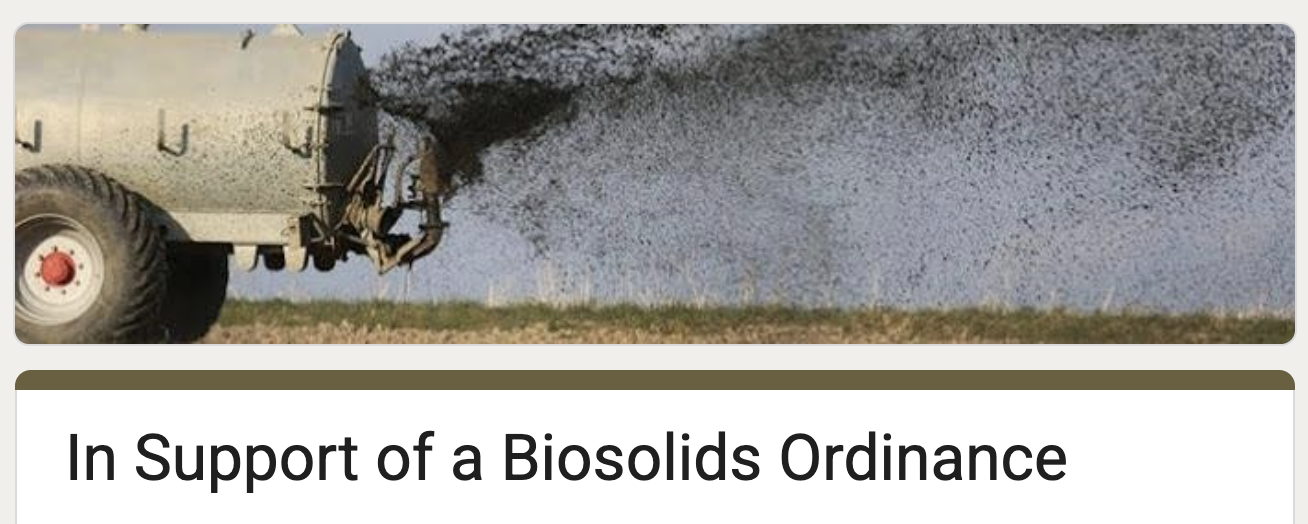
Ready to Sign On?
Fill out this form to add your name and organization.
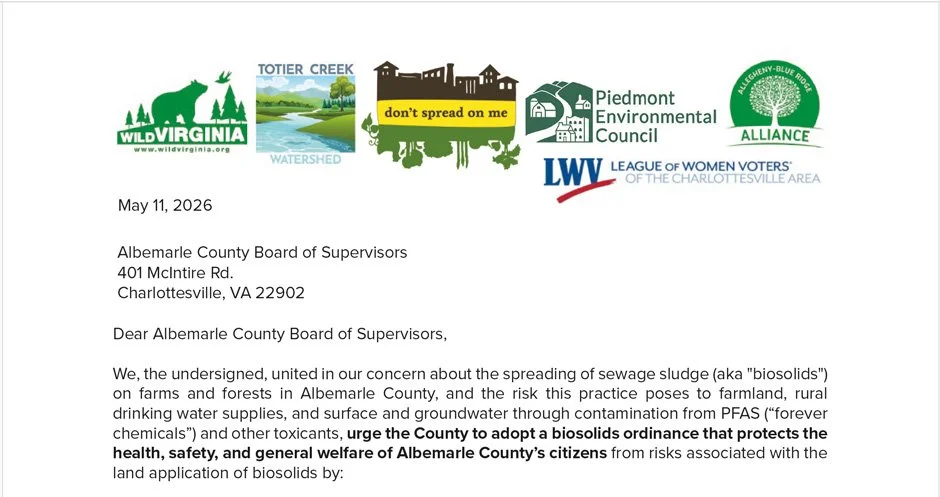
Read the Letter
View or download a pdf of the support letter here.
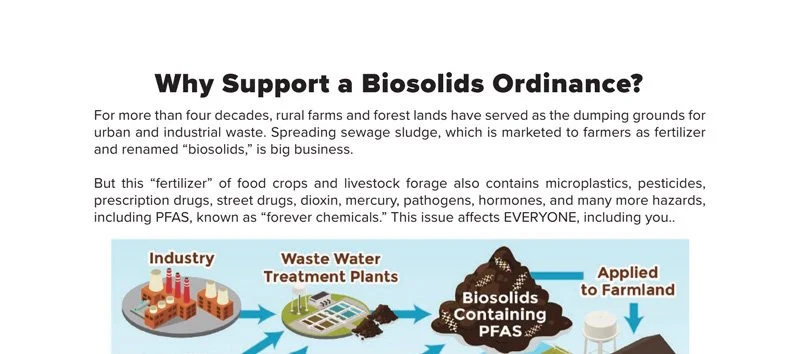
See the Fact Sheet
Learn why an ordinance is needed or share with a friend, here.
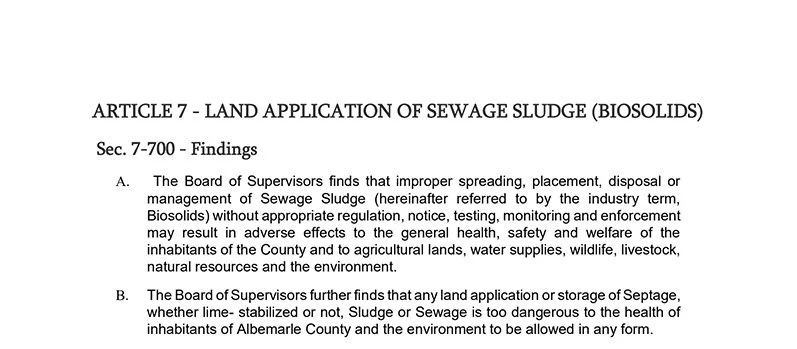
Dig deeper.
Read a draft ordinance DSOM prepared for the county, plus supporting documents, here.

The Albemarle County Board of Supervisors meets twice monthly at the County office building in Charlottesville.
Local Government:
Albemarle County Board of Supervisors
Our elected Board of Supervisors are the ones who pass ordinances and approve regulations that affect every aspect of life in the County. Regularly attending meetings and submitting comments is an important way of getting the supervisors to pay attention to an issue.
Members of Don’t Spread On Me have been asking the Board of Supervisors to adopt a biosolids ordinance. We have even written a draft ordinance for them to use as a starting point in the adoption process. State case law has pre-empted local control over issuing a ban or a moratorium on the land application of biosolids, but counties can establish a testing and monitoring program through an ordinance.
If you would like to help urge the Supervisors to adopt an ordinance, or you want help with writing an ordinance for your own county Board, contact us.
Find your supervisor
You can find what district you’re in, which supervisor represents you, and read more about them at this page on the County website.
Participate
The Participation Guide for Board of Supervisor Meetings contains details and instructions about submitting comments to the Supervisors. They meet on the first and third Wednesday of every month. Keep up with meetings and agendas via the County Calendar page. Note that, in addition to emailing your comments to the Supervisors at BOS@albemarle.org, you may also submit written comments via an online portal. Those comments are visible to the public and become part of the public record.
To submit ecomments, start here. You’ll need to register or login, then click the link for the meeting you want to comment on. You’ll see further instructions in the window that opens and a list of agenda items below that. The items that are open for comment will have a grey box beneath them that says “Comment.” Click on that to submit your comments. If the item you wish to comment on isn’t on the agenda, you may still submit comments under the section called “From the Public.”
Legislative Priorities
The Board of Supervisors also presents the County’s legislative priorities to the Virginia General Assembly every January. This is another opportunity to bring the issue before the Board and ask them to include language about state-level legislative efforts such as enacting a moratorium, creating a relief fund for farmers affected by contaminated land, and establishing state grants to fund research on mitigation and solutions.

State Government: The Virginia General Assembly
Our elected legislators have had well-funded industry groups lobbying and pushing the narrative that sludge is safe for decades. They need our help to bring them information that counteracts that narrative. They also need to know that their constituents care about this issue.
Communicate
Start by putting your address into the General Assembly’s Who is My Legislator tool. Click on the “More Info” link below your state senator or delegate’s name, and it will take you to their profile page, which includes their contact information.
Once you have educated yourself about biosolids (use our Articles & Webinars page!), get in touch with your state senator and delegate.
Whichever method you choose, please include this message in your own words:
PFAS have been found in nearly every sample of biosolids that have been tested for it. Virginia needs to follow Maine’s lead and issue a state-wide moratorium on the land application of sludge, along with establishing a testing regime and a fund that will compensate farmers whose lands have been ruined.
Using the contact info from the General Assembly profile pages, you can:
Write them a letter. An old-fashioned USPS letter is still the most impactful way to reach your elected officials. Consider printing an article or two and enclosing it along with your letter. (We like this Virginia Mercury article.)
Make an appointment to meet them face-to-face. Call their office in Richmond to meet during a session, or call their district office to meet there when they are not in session.
Send them an email (or two or three…) along with links to articles or other info you think they should know about.
Participate
Some environmental groups have established annual days on which they bring their agenda and suggestions to members of the General Assembly and the public is invited to come along. You can register to join these groups and talk to your legislators during the January session:
Virginia Clean Water Lobby Day by the Chesapeake Bay Foundation. Find it on their calendar.
Conservation Lobby Day by Virginia Conservation Network.
Sign up for their newsletters to find out when these events and other action alerts are happening. Also visit Our Allies and get on the list for some of those groups to stay in the loop.